For the love of local!
An invitation to deeper relationship
Dear Friends and Neighbors,
Here at Lost Valley / Meadowsong Ecovillage, we’ve been quietly growing food, restoring our soils and forests, and learning together for over 36 years. Most of our larger education programs offer full immersion on land within our community, drawing people from across the country and around the world.
However, given the turbulent times we are living in today, we want to do more to strengthen local networks. We believe that resilience and long term solutions to the global polycrisis are cultivated through living relationships of interdependence and reciprocity in place. Thus, we want to provide more opportunities for local folks to connect to each other and to earn the tools for ecological and cultural regeneration that are specific to our shared valley home.
That’s why we’re starting “For the Love of the Local”, a simple, sweet, low-volume newsletter for folks who make their home within and around the neighborhoods of Dexter, Lowell, Pleasant Hill, Cottage Grove, Veneta, the greater Eugene-Springfield area, and Oakridge. Even if you do not live in these areas, we hope you enjoy the deeper exploration as to the power of place and local relationships in the analysis below.
When you opt in, you’ll be the first to hear about:
Free half-day and evening community resilience workshops (seed-saving, fire mitigation, permaculture gardening, herbal medicine, and more).
Monthly neighborhood work parties to support our closest neighbors in Dexter, Lowell, and Pleasant Hill.
Community potlucks, skill-shares, and seasonal celebrations that are open and relaxed—no need to commit to anything long-term.
Last-minute invitations and CSAs when we have extra produce, plant starts, or firewood to share.
Special scholarship opportunities in our upcoming courses specifically for residents of Lane county!
Click here to sign up for localized news & updates!
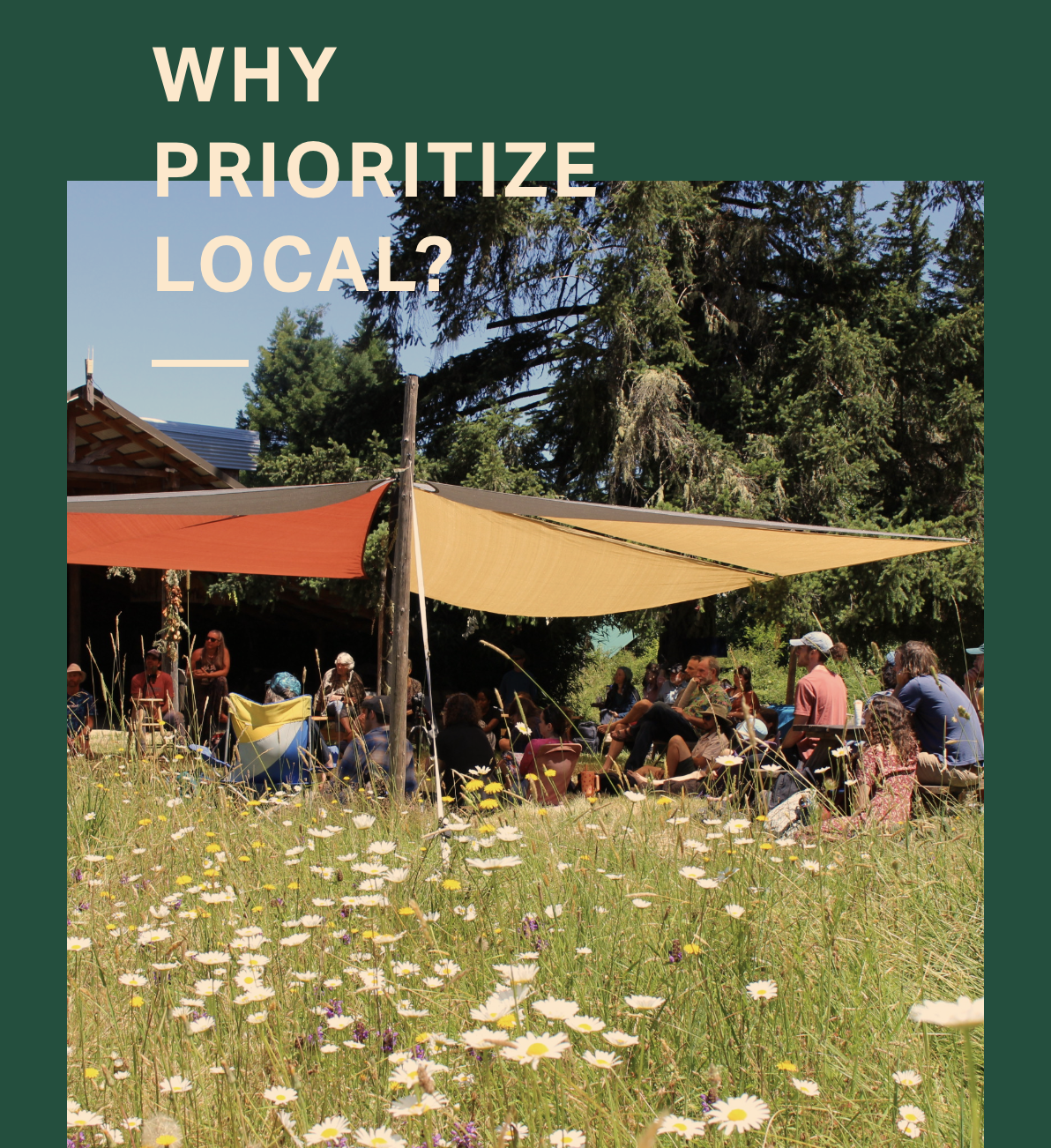
Tight knit local networks are the beating heart of community resilience, cultural and relational richness, and disaster preparedness.
In attending to local and neighborhood relations, we can better navigate challenges, support one another, and more effectively steward the unique possibilities of abundance and fertility offered by this lush valley. We can also participate in deeper forms of collective agency, cultivating powerful possibilities for youth education, food sovereignty, and economic and cultural revitalization. Below are some central reasons and local examples to highlight why the work of uniting our communities is so essential within the context of the Willamette Valley.
1. Improved Disaster Preparedness and Response
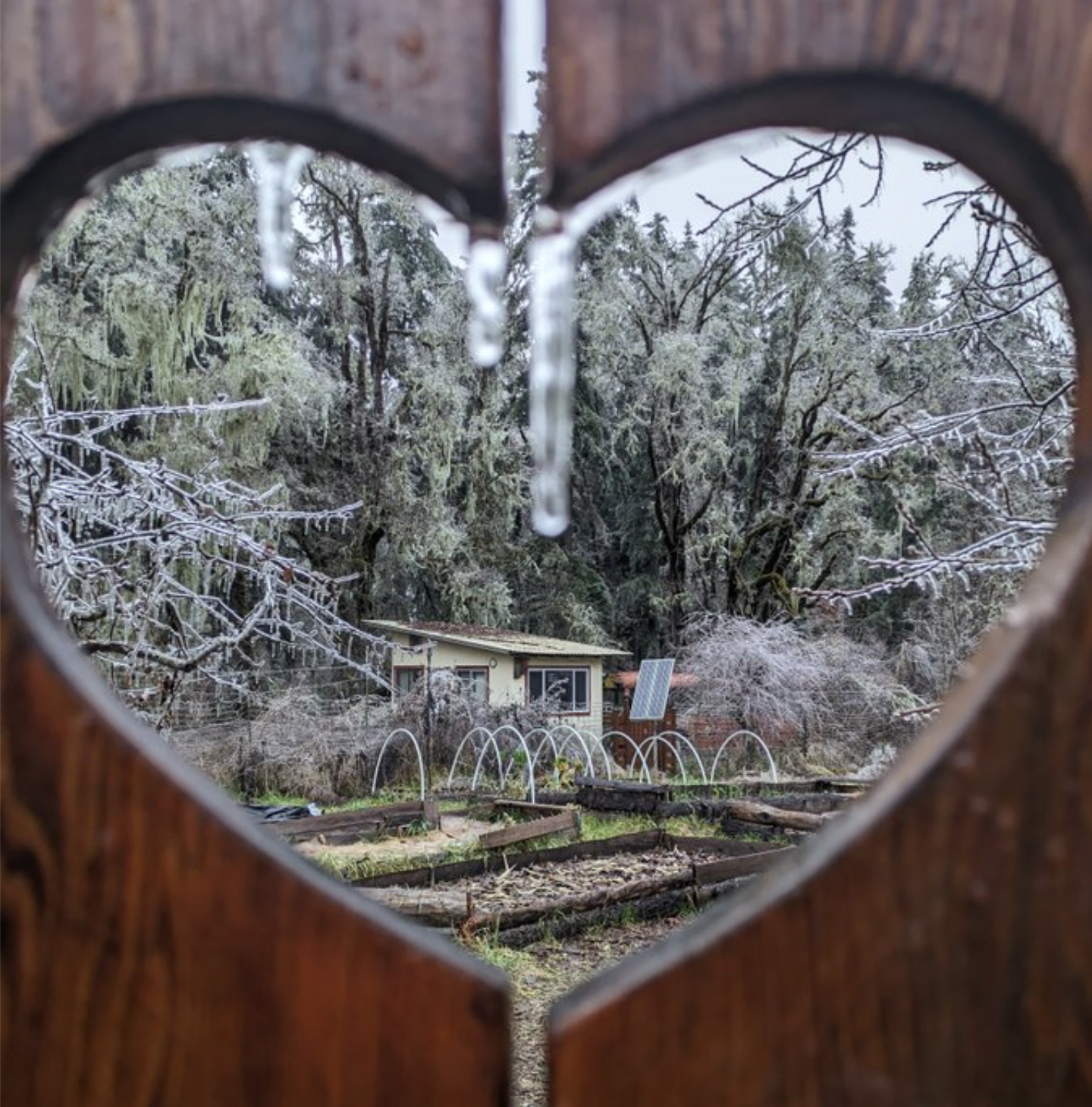
The Willamette Valley is highly vulnerable to natural disasters such as wildfires, floods, earthquakes, and extreme weather events. Strong local relationships support faster, more effective mutual aid when external help is delayed or overwhelmed, saving lives and reducing long-term damage.
For instance, the 2021 ice storm caused widespread power outages across Salem, Eugene, and surrounding areas, but local resilience hubs and community groups filled gaps by offering warming centers and resource sharing. The local Pleasant Hill Baptist Church responded swiftly during the ice storm by organizing approximately 50 work parties in a span of two months to free community members from the large branches and debris that trapped them at home. They also showed up with a significant work force to our most recent Neighborhood Work Party⎯thank you, Pleasant Hill Baptist! The 2024 ice storm also brought our residents here at Meadowsong Ecovillage closer together, showing how crises can become gifts of connection and greater resilience for small communities.
Sign up here if you would like to receive help or participate in future neighborhood work parties!
2. Economic Stability and Self-Sufficiency
Local networks of relationship reduce dependency on fragile global supply chains, keeping resources circulating within the community and bolstering jobs in key sectors like agriculture and tourism. As people of place, we are tied together through economic exchange, mutual responsibility, and greater social accountability.
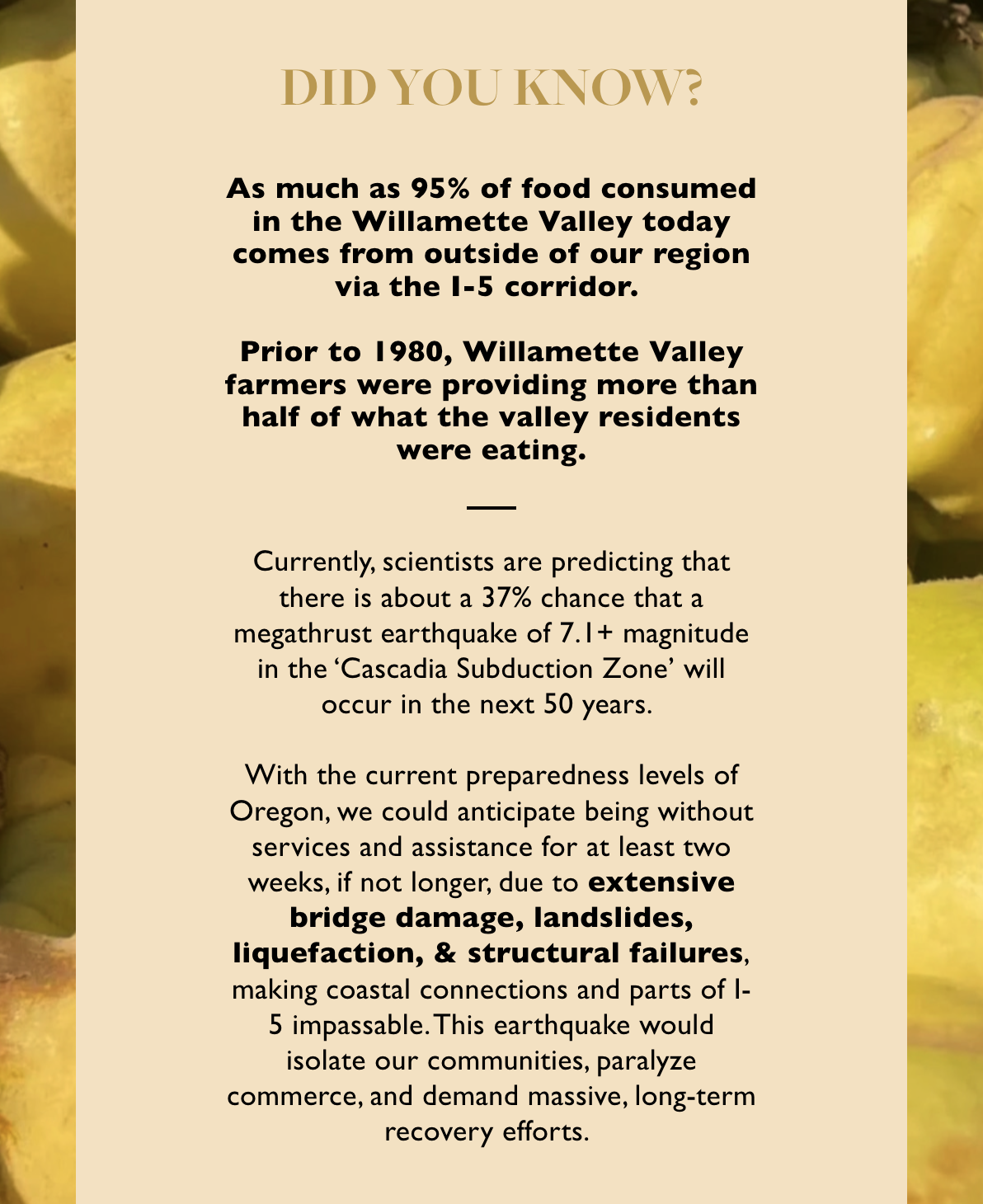
For example, a local, family-owned farm is bound by social contracts to provide service and value to it's community of origin in ways that large corporate farms are not. While small farms make up over 60% of the farms in the region, they account for less that 2% of farmland currently in use. The result is that the majority of food produced from our rich soils is mono-cropped and exported for highest dividends. In fact, the majority of crops produced here is not food at all⎯approximately 60% of the farmland in the Willamette Valley is dedicated to growing grass seed for sports fields, lawns, and animal forage nationally and worldwide! Approximately 15-20% of this seed is exported to over 70 foreign countries, while the rest supplies two-thirds of the U.S.'s cool-season grass seed.
Small farmers and other family-owned operations are the beating heart of self-sufficiency, economic opportunity and food sovereignty on the local level, and they can only thrive when we prioritize buying from⎯and relating with⎯our local producers.
Check out Lane County Farmers Market and Local Harvest for information on how to support local farms through direct subscriber relationships, ensuring food security even during major disruptions and supply chain issues.
3. Environmental Sustainability and Resource Management
Building community resilience promotes collaborative stewardship of the valley's natural assets, such as its rivers, forests, and farmlands, which are under pressure from extractive industries and climate impacts. Local relationships enable joint efforts to protect ecosystems while addressing shared challenges.
Here are some illustrative examples of local efforts towards collaborative stewardship:
— The Willamette River Initiative brought together diverse groups, both urban and rural and across racial and ideological divides, to restore the river's health. This collaborative effort and ongoing partnerships have improved water quality and habitat for salmon runs, which are essential to the region's biodiversity and economy.
— Our friends and partners at the Center for Rural Livelihoods are organizing across Lane County to facilitate deeper community resilience and models for collaborative stewardship, such as the development of cooperatives. They offer ecological and regenerative forestry education for youth and adults, helping to (a) better utilize forest products, (b) regenerate forest ecosystems for long term abundance, and (c) generate jobs to do this work at the scope it is needed.
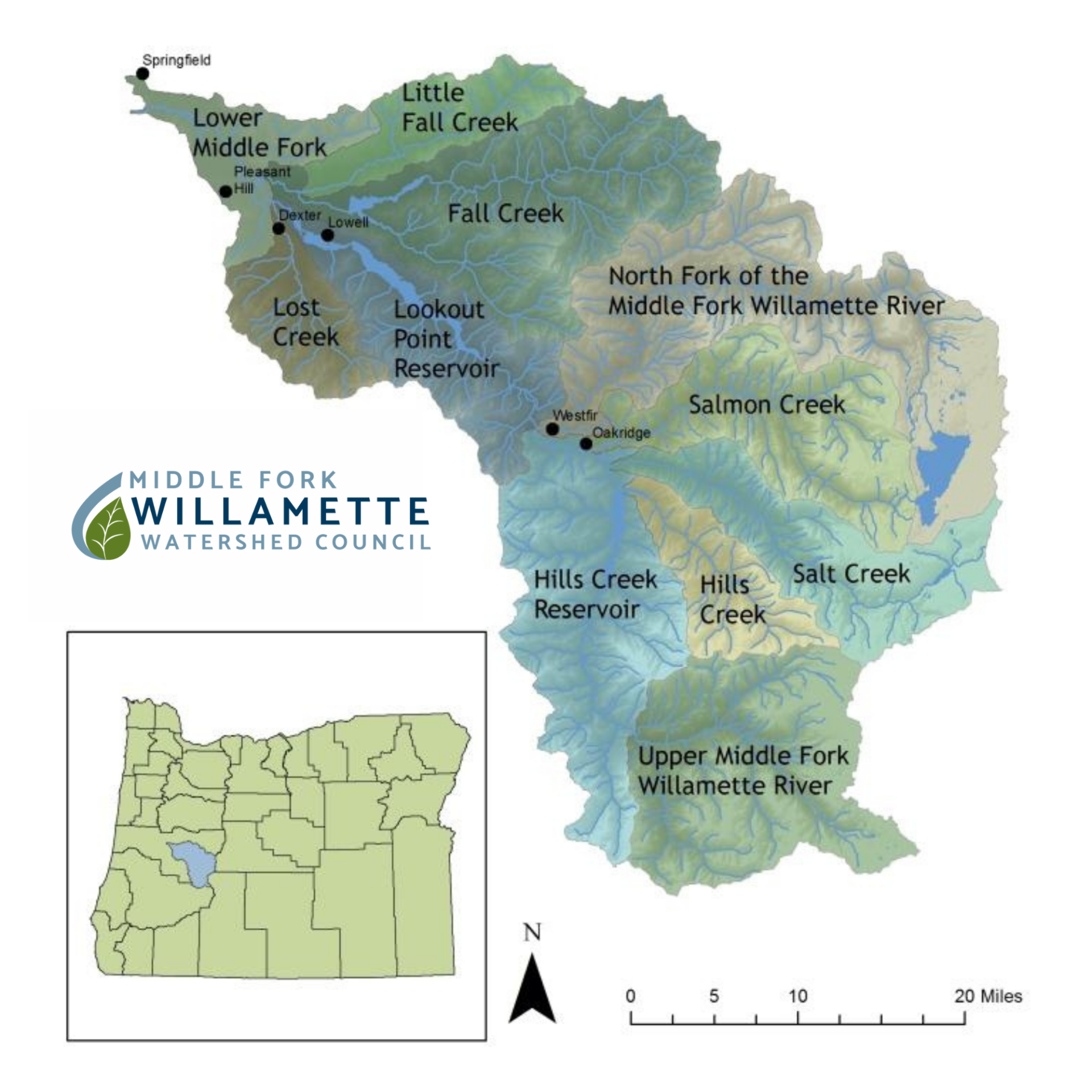
— Watersheds are the most natural delineation of place, and Watershed Councils are fantastic, reliable mediators between the human and non-human worlds within said place.
In 2025, Lost Valley worked with the Middle Fork Watershed Council and the Upper Willamette Soil and Water Conservation District (UWSWCD) as the recipient of an Oak Woodland Restoration Impact Grant (read the full newsletter report here). UWSWCD offers these local conservation grants to community organizations, non-profits, and landowners alike to support ecologically regenerative efforts throughout our area.
Connect with your local watershed council for more resources and information to support local, collaborative stewardship efforts!
4. Sociocultural Cohesion and Well-Being
Rates of depression, anxiety, isolation, and suicide have risen at alarming rates in the 20-30 years, particularly in younger populations. While national spending on modern health care has gone up, our physical and mental health continues to go down. Strong local relationships combat isolation, build trust, and enhance mental and physical health in ways that the medical industrial complex cannot touch. How can we start to re-prioritize our original human systems of mutual care so as to build the necessary cultural and relational infrastructure for youth (and all people) to thrive?
Cultural gatherings and events, collaborative arts and skill-sharing, intergenerational connection, and community-based initiatives are all important ways to build supportive networks and facilitate cross-cultural pollination. Public or semi-public spaces such as granges, schools, churches, farmer's markets, and education centers (hey!) can offer regular opportunities for folks to gather, engage and discuss important issues, and learn new skills. Ancestral and Indigenous knowledge can offer us time-tested tools and arts for re-weaving our relationship to place and celebrating our shared human existence upon this flowering Earth. Together, these spaces, events, arts and tools foster shared identity and a sense of belonging that buffers against social fragmentation and polarization.
Together, we can remember and recover our stories of place and lineage. Together, we must learn how to listen, resolve differences, integrate and celebrate diversity, and show up for one another in real time and real places. By tending to place and investing in relationships, we can leave future generations not just with material infrastructure, but a living culture and heritage of place, peace, and resilience in times to come.
Check out our Social Forestry Camp, Community Experience Week, and Uywanakuy: Ancestral Arts Workshop for great opportunities to learn more about tending to culture, community, and place in 2026!
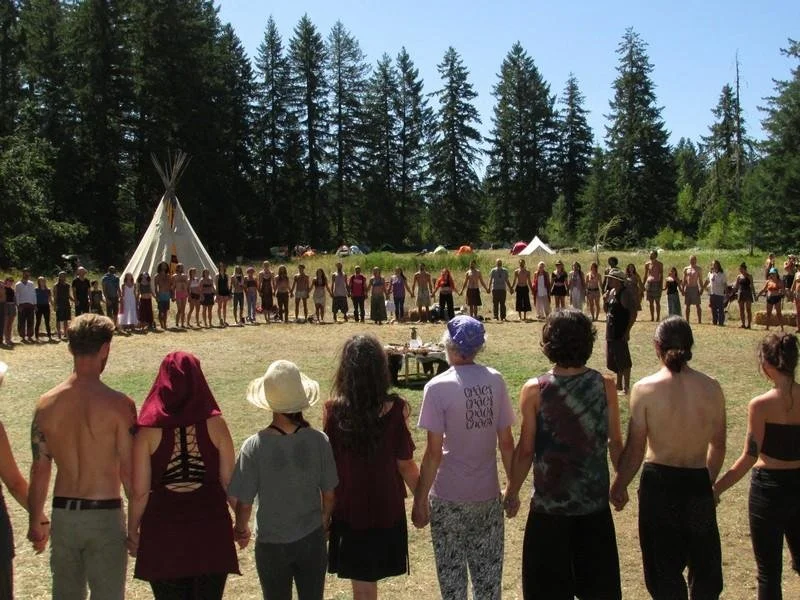
We hope you heed this call to deeper relationship, community resilience, and the co-creation of more vibrant, beautiful, coherent lives and livelihoods for all involved.
May we thrive together in 2026⎯for the love of the local!
Check out the following Social Forestry courses for learning ecological skills in conjunction with place-based stewardship, network building, and cultural revitalization! For other planned courses in 2026 so far, visit the Education tab above.
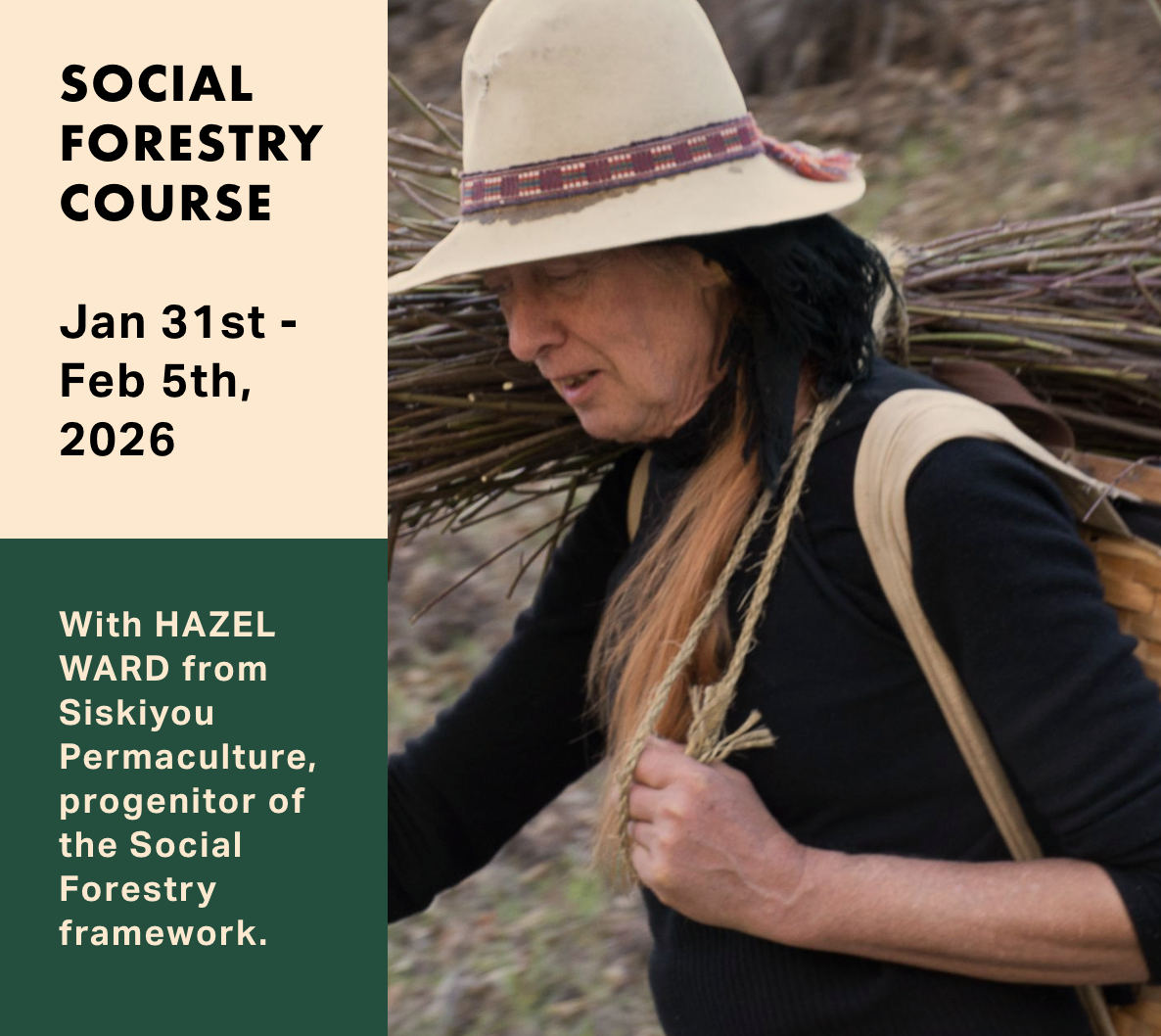
We are thrilled to welcome our beloved elder, Hazel Ward, to Lost Valley this month for a full Social Forestry Course!
Social Forestry offers a framework for culture tending that weaves ecological stewardship with ritual, seasonal work and place-based living. The course supports a vision of a cottagers’ co-op, stewardship contracts with ecological covenants, semi-nomadic seasonal work patterns and cultural support for a new/old way of being in relationship with our forests and landscapes. Check out Hazel's book here.
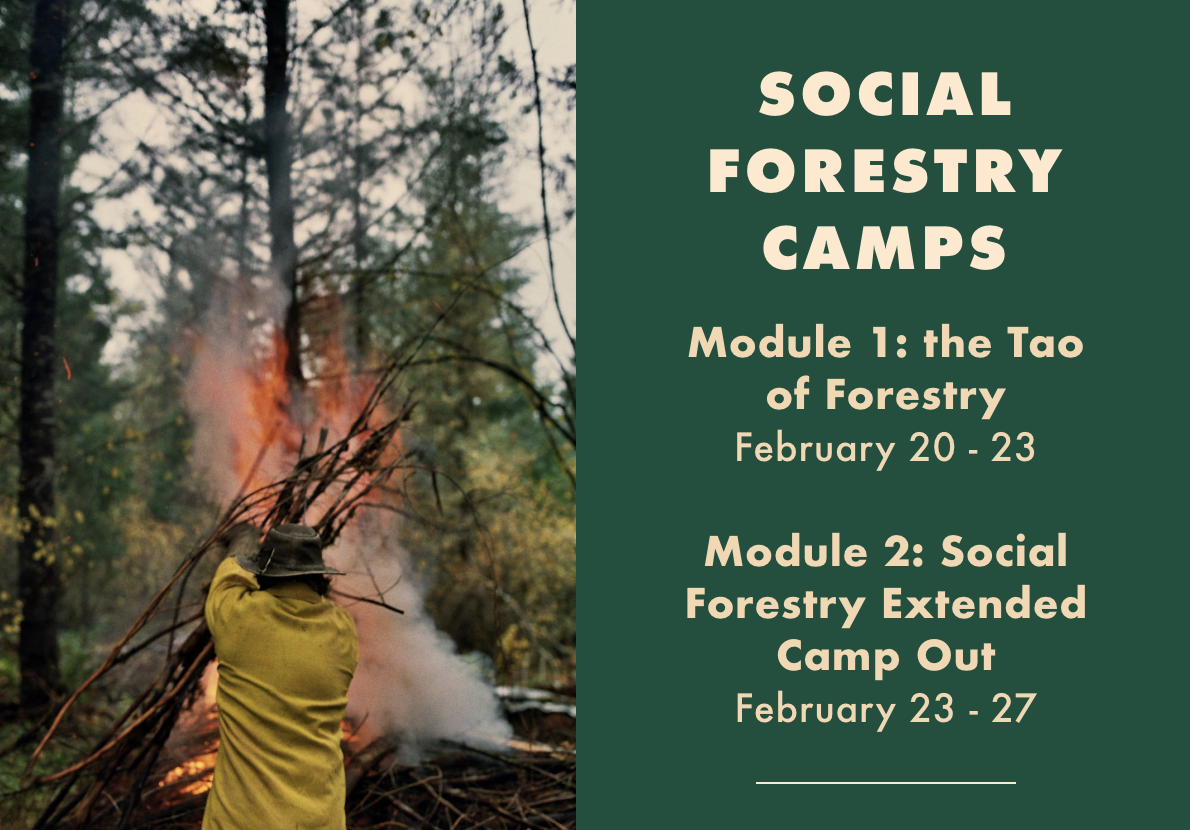
Join us for one or both modules guided by Lost Valley Land Steward and Permaculture Teacher, Brian Byers and Nature’s Mystery Founder, Nathaniel Nordin-Tuininga.
Inspired by Hazel Ward, our camp aims to build a culture of ecological literacy, social connection, and leadership skills for the regeneration of our watersheds, forests, oak savannas, and human communities. Come to share and practice your skills in a community of passionate people and forest guardians! Sign up here.
Thanks for reading!
Sincerely,
Lost Valley Education Center